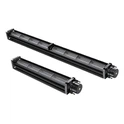
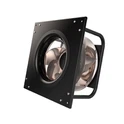
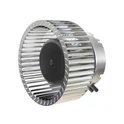
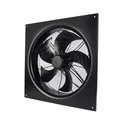
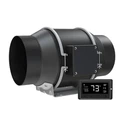
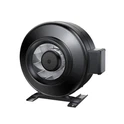
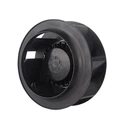
A centrifugal blower fan, also known as a centrifugal fan or squirrel cage fan, is widely used in various applications due to its robust design and high efficiency. Here are the key features of a centrifugal blower fan:

Design and Construction:
Impeller: The main component, usually consisting of a series of blades or vanes, arranged around a central hub.
Housing: Encloses the impeller and directs the airflow in and out of the fan.
Inlet and Outlet: Typically features a single or double inlet, and the outlet is often at a 90-degree angle to the inlet.
Airflow Characteristics:
High Pressure: Capable of producing high static pressure, making it suitable for applications requiring significant air movement against resistance.
Stable Airflow: Provides consistent and stable airflow, which is beneficial for processes requiring uniform air distribution.
Types of Blades:
Forward-Curved Blades: More blades that are curved in the direction of the rotation, suitable for low-pressure and high-volume applications.
Backward-Curved Blades: Fewer blades that curve against the direction of rotation, offering higher efficiency and better handling of high-pressure applications.
Radial Blades: Straight blades that radiate out from the hub, used for handling particulate-laden or abrasive air streams.
Performance Characteristics:
Efficiency: High-efficiency levels, particularly in backward-curved and radial blade designs.
Noise Levels: Generally quieter than axial fans due to the housing design, although noise levels can vary based on the specific design and application.
Flow Rate: Can move large volumes of air, with specific designs optimized for different flow rates and pressures.
Versatility and Applications:
HVAC Systems: Commonly used in heating, ventilation, and air conditioning systems to circulate air and maintain indoor air quality.
Industrial Applications: Employed in dust collection systems, material handling, combustion air supplies, and other industrial processes.
Cooling Systems: Used in cooling electronic equipment, machinery, and other applications requiring efficient heat dissipation.
Durability and Maintenance:
Materials: Constructed from a variety of materials, including steel, aluminum, and plastic, depending on the application and environmental conditions.
Maintenance: Generally low maintenance, with routine inspections and cleaning required to ensure optimal performance and longevity.
Customization:
Variety of Sizes and Configurations: Available in different sizes and configurations to meet specific requirements, including single or double inlet designs and various mounting options.
Variable Speed Control: Many models offer variable speed control to adjust airflow and pressure as needed.
Safety Features:
Explosion-Proof Designs: Available for use in hazardous environments where flammable gases or dust may be present.
Protective Grills and Enclosures: Often included to prevent debris from entering the fan and to protect users from moving parts.
These features make centrifugal blower fans highly adaptable and effective for a wide range of applications, from residential and commercial HVAC systems to industrial processes and equipment cooling.