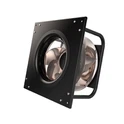
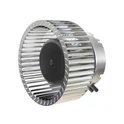
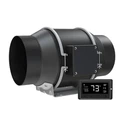
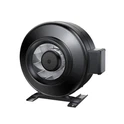
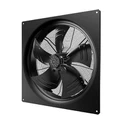
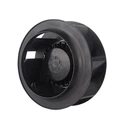
The forward and backward centrifugal fans mainly refer to the different blades of the assembled fan. The forward type is generally called a blower, and the backward type is generally called an induced draft fan. The difference is the length of the impeller crosspiece and the impeller edge.
The forward direction is parallel to the edge of the impeller, and the exit angle of the impeller is greater than 90 degrees. The forward impeller is also called the forward impeller. The forward impeller is mostly high-pressure. The backward direction is not parallel to the impeller, and the length is a few centimeters or several millimeters from the edge of the impeller. It means that the exit angle of the impeller is less than 90 degrees. The backward impeller is also called the backward impeller. The backward impeller is mainly of medium pressure.
There are three main differences:
① Power
The static pressure head used to overcome the resistance of the system, the forward centrifugal fan is smaller than the backward centrifugal fan. Since the channel in the backward blade fan is gradually enlarged, its hydraulic loss is smaller than that of the forward type. Therefore, the efficiency of the forward centrifugal fan is lower than that of the backward centrifugal fan.
② Energy consumption
Since the efficiency of the forward centrifugal fan is lower than that of the backward centrifugal fan, its power consumption is greater than that of the backward centrifugal fan.
③ Noise
The operating noise of the forward centrifugal fan is greater than that of the backward centrifugal fan.