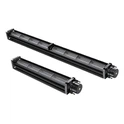
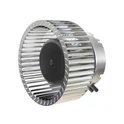
Cross-flow fan, also called cross-flow fan, was first proposed by French engineer Mortier in 1892. The impeller is multi-blade, long cylindrical and has forward multi-wing blades. Its structure is shown in Figure 1. When the impeller rotates, the airflow enters the cascade from the open part of the impeller, passes through the interior of the impeller, and is discharged into the volute from the other side of the cascade to form a working airfloshe impeller, the center is located near the volute tongue. The existence of the vortex causes a circulating flow at the output end of the impeller. Outside the vortex, the air stream in the impeller is arc-shaped.
Therefore, the flow velocity of each point on the outer circumference of the impeller is not consistent. The closer to the vortex center, the higher the speed, and the closer to the volute, the lower the speed. The air velocity and pressure at the air outlet of the fan are not uniform, so the flow coefficient and pressure coefficient of the fan are average values. The position of the vortex has a greater impact on the performance of the cross-flow fan. The center of the vortex is close to the inner circumference of the impeller and close to the volute tongue, and the performance of the fan is better; The degree of stability increases.