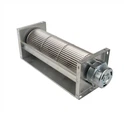
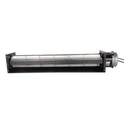
CFD analysis, or Computational Fluid Dynamics analysis, is a powerful tool that has revolutionized the way we understand and optimize the performance of cross flow fans. As a cross flow fan supplier, I've witnessed firsthand how CFD analysis can significantly enhance the design, efficiency, and overall quality of our products. In this blog post, I'll delve into what CFD analysis of a cross flow fan entails, its benefits, and how it impacts our business and customers.
Understanding Cross Flow Fans
Before we dive into CFD analysis, let's briefly review what cross flow fans are. Cross flow fans, also known as tangential fans, are widely used in various applications, including air conditioning units, refrigerators, ventilation systems, and even elevators. Unlike traditional axial or centrifugal fans, cross flow fans have a unique blade arrangement that allows air to flow through the impeller in a perpendicular direction to the shaft. This design enables them to produce a relatively high-volume, low-pressure airflow in a compact and efficient manner.
We offer a diverse range of cross flow fans to meet the specific needs of our customers, including DC Cross Flow Fan, AC Cross Flow Fan, and Elevator Cross Flow Fan. Each type of fan is engineered to deliver optimal performance in its respective application, whether it's providing precise temperature control in a small electronic device or ensuring proper ventilation in a large elevator car.
What is CFD Analysis?
Computational Fluid Dynamics (CFD) is a branch of fluid mechanics that uses numerical methods and algorithms to solve and analyze problems involving fluid flow. In the context of cross flow fans, CFD analysis involves creating a virtual model of the fan and simulating the airflow around and through it. This simulation allows us to visualize and quantify various aspects of the fan's performance, such as air velocity, pressure distribution, and flow patterns.
To perform a CFD analysis of a cross flow fan, we first need to create a detailed 3D model of the fan, including the impeller, housing, and any other relevant components. This model is then imported into a CFD software package, where we define the boundary conditions, such as the inlet and outlet pressures, temperature, and airflow rates. The software then uses mathematical equations to solve the governing equations of fluid motion, such as the Navier-Stokes equations, to predict the behavior of the airflow within the fan.
Benefits of CFD Analysis for Cross Flow Fans
There are several key benefits of using CFD analysis in the design and optimization of cross flow fans:
1. Performance Optimization
CFD analysis allows us to identify areas of the fan design that may be causing inefficiencies or performance issues. By analyzing the airflow patterns and pressure distributions within the fan, we can make targeted modifications to the impeller geometry, blade shape, or housing design to improve the fan's efficiency, airflow rate, and pressure rise. This optimization process can lead to significant energy savings and improved performance in real-world applications.
2. Noise Reduction
Noise is a common concern in many applications where cross flow fans are used. CFD analysis can help us understand the sources of noise generation within the fan, such as turbulent airflow, blade passing frequencies, and flow separation. By making design changes based on the CFD results, we can reduce the noise levels produced by the fan without sacrificing performance. This is particularly important in applications where quiet operation is essential, such as in residential air conditioning units or office ventilation systems.
3. Cost Savings
Traditional methods of fan design and testing often involve building physical prototypes and conducting extensive experimental testing. This process can be time-consuming, expensive, and may not always provide a complete understanding of the fan's performance. CFD analysis, on the other hand, allows us to virtually test different design concepts and configurations before building any physical prototypes. This reduces the number of prototypes required, saves time and money, and accelerates the product development cycle.

4. Customization and Innovation
CFD analysis gives us the flexibility to design and optimize cross flow fans for specific applications and customer requirements. By simulating different operating conditions and design parameters, we can develop customized fan solutions that meet the unique needs of our customers. This allows us to stay ahead of the competition and drive innovation in the cross flow fan industry.

How CFD Analysis Impacts Our Business and Customers
As a cross flow fan supplier, CFD analysis plays a crucial role in our business operations and the value we provide to our customers. Here's how:
1. Product Quality and Reliability
By using CFD analysis to optimize the design of our cross flow fans, we can ensure that our products meet the highest standards of quality and reliability. Our fans are engineered to deliver consistent performance, energy efficiency, and quiet operation, which helps our customers achieve their desired outcomes in their applications. This, in turn, enhances our reputation as a trusted supplier of high-quality cross flow fans.
2. Customer Satisfaction
CFD analysis allows us to offer customized solutions that meet the specific needs of our customers. Whether it's a unique airflow requirement, a space constraint, or a noise limitation, we can use CFD simulations to design and develop a cross flow fan that perfectly fits the customer's application. This level of customization and attention to detail helps us build strong relationships with our customers and ensures their satisfaction with our products.

3. Competitive Advantage
In today's competitive market, having a cutting-edge design and technology is essential for success. CFD analysis gives us a competitive edge by allowing us to develop innovative fan solutions that are more efficient, quieter, and more reliable than those of our competitors. This enables us to differentiate ourselves in the market and attract new customers who are looking for high-performance cross flow fans.
Conclusion
In conclusion, CFD analysis is a powerful tool that has transformed the way we design, optimize, and manufacture cross flow fans. By using CFD simulations to understand the airflow behavior within the fan, we can improve its performance, reduce noise levels, save costs, and offer customized solutions to our customers. As a cross flow fan supplier, we are committed to leveraging the latest CFD technology to provide our customers with the highest quality products and the best possible value.
If you're interested in learning more about our cross flow fans or discussing your specific application requirements, we encourage you to contact us for a procurement consultation. Our team of experts is ready to assist you in finding the perfect cross flow fan solution for your needs.
References
- Anderson, D. A., Tannehill, J. C., & Pletcher, R. H. (1984). Computational Fluid Mechanics and Heat Transfer. McGraw-Hill.
- Versteeg, H. K., & Malalasekera, W. (2007). An Introduction to Computational Fluid Dynamics: The Finite Volume Method. Pearson Education.
- White, F. M. (2011). Fluid Mechanics. McGraw-Hill.