The technology and performance of heat dissipation fans have reached a mature stage, with new technologies constantly emerging.
Fans come in sizes ranging from 8 millimeters to 630 millimeters, with voltages including 5V, 12V, 24V, 48V, 110V, 220V, and 380V, in various shapes such as square, circular, or olive-shaped.

Based on the different airflow directions, fans are categorized into four types:
Axial Fans
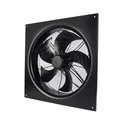
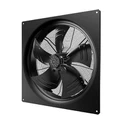
Axial fans have blades that cause air to flow in the same direction (parallel direction) as the axis.
The impeller of an axial fan is similar to a propeller. When it operates, the majority of airflow flows parallel to the axis, meaning along the axis.
Axial fans consume the least amount of power when the inlet airflow is at zero static pressure.
During operation, power consumption increases with an increase in backpressure.
Axial fans are commonly installed in the cabinets of electronic and electrical equipment or integrated with motors. Their compact structure saves a lot of space and makes them easy to set up, thus they are widely used.
Most square heat dissipation fans seen on the market fall into this category.
Key characteristics of axial fans: meeting high airflow velocity, medium air pressure, and ordinary environment cooling requirements.
Mixed Flow Fans
Mixed flow fans are also called oblique flow fans.
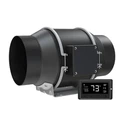
These fans have a similar appearance to axial flow fans.
In fact, the inlet of a mixed flow fan is along the axis, while the outlet is in the diagonal direction along the axis and perpendicular to it.
The blades and hood of this fan are conical, resulting in high air pressure. Compared to axial flow fans of the same size and comparable performance, mixed flow fans produce lower noise levels than centrifugal fans.
The main characteristics of mixed flow fans are achieving better cooling under high airflow velocity and relatively high air pressure.
Centrifugal Fans
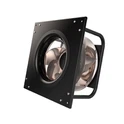
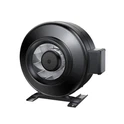
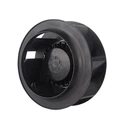
When a centrifugal fan operates, the blades cause air to flow perpendicular to the axis, with intake along the axis and exhaust perpendicular to it.
In many cases, using axial fans can achieve cooling effects. However, if there is a need to discharge airflow by rotating it 90 degrees or if high air pressure is required, centrifugal fans may be necessary.
Strictly speaking, fans also belong to centrifugal fans.
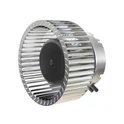
The image described is that of a small centrifugal fan. We commonly use multi-blade centrifugal fans in machinery. Although their appearances differ, their principles are the same.
Key characteristics of centrifugal fans: changing the inflow of air, comparing well with airflow rates, high air pressure.
Cross Flow Fans
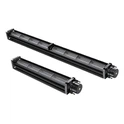
Cross-flow fans, also known as tangential fans, can generate a large-scale airflow and are generally used to cool broad surfaces of equipment.
The intake and exhaust of these fans are perpendicular to the axis.
Cross-flow fans work using relatively long cylindrical fan impellers with a large diameter. This design allows them to maintain overall air circulation while operating at lower speeds, thus reducing noise caused by high-speed rotation.
They are commonly used in elevators, air conditioning systems, automobiles, etc.
Key characteristics of cross-flow fans: low flow velocity, low air pressure, large heat dissipation area.