Why Choose Forward Centrifugal Fans? - Fan Type Introduction
Selecting a Fan for Optimal Performance
Choosing the right fan involves considering two key factors: the required airflow rate and the pressure the fan needs to overcome. This combination of airflow and pressure defines the fan's duty point. To achieve optimal performance, you'll want to select a fan whose performance curve intersects your duty point at or near its peak efficiency. Operating the fan at its peak efficiency minimizes power consumption and noise output while delivering the required airflow.
How does Forward Curved Centrifugal Fan work?
Forward-curved centrifugal fans, like their backward-curved counterparts, are named for their air path. Air enters axially and exits at a 90-degree angle. However, the key difference lies in the impeller blade design. Unlike backward-curved blades, forward-curved ones have a more shallow design that pushes air tangentially from the impeller's circumference.


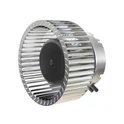
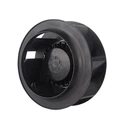
A forward curved centrifugal fan is characterised by its cylindrical shape and lots of small blades on the circumference of the impeller. In the example shown below, the fan rotates in a clockwise direction.

Unlike the backward curved impeller, the forward curved impeller requires a housing that converts high velocity air leaving the tips of the impeller blade into a lower velocity static force. These fans are housed in a scroll volute that plays a crucial role. The scroll takes the high-velocity air exiting the blades and converts it into a lower-velocity, but higher-pressure flow directed towards the outlet.
Forward-curved fans come in two main configurations:
Single inlet: Draws air from one side and discharges it from a perpendicular outlet.
Double inlet: Draws air from both sides for higher flow rates at a compact size, discharging it from a wider outlet.

The single inlet blower on the left, draws in air from one side of the housing through the round inlet and directs it to the square outlet, (seen here with a mounting flange). The double inlet blower has a wider scroll housing drawing air in from both sides of the scroll delivering it to the wider square outlet.
As with the backward curved centrifugal fan, the suction side of the impeller blade draws air from the centre of the fan which results in a directional change of the airflow between the inlet and the exhaust of 90°.
Forward Centrifugal Fan Characteristic
The optimum operating area for a forward curved centrifugal fan is when it is operating at higher pressure. A forward curved centrifugal fan works best when high pressures against lower volume flows are required. The graph below illustrates the optimum working area:

The X-axis of the graph represents volume flow, while the Y-axis represents system pressure. In the absence of system pressure (when the fan is freely blowing), a forward-curved centrifugal fan generates the highest volume flow. However, as resistance on the suction or exhaust side increases, the volume flow rate decreases.
It's important to be cautious when choosing a forward-curved blower for low-pressure operations with maximum volume flow. In such scenarios, the impeller operates in an aerodynamic stall similar to an axial fan at its curve's saddle point, leading to increased noise and power consumption due to turbulence.
The point of peak efficiency, known as the knee of the characteristic curve, occurs when the ratio of output power (volume flow x static pressure development) to electrical power input is at its maximum, and the fan produces minimal sound pressure. Beyond this optimal range, both noise levels and system efficiency decrease.
A single inlet forward-curved motorized impeller offers a steep fan characteristic, ideal for applications requiring consistent filtration levels. As air passes through a particulate filter, finer filtration grades capture smaller particles, gradually clogging the filter and increasing pressure. The steep characteristic curve of the impeller ensures a constant volume flow even as filter pressure rises.
On the other hand, a double inlet forward-curved impeller, despite its smaller size, can deliver high-volume flow. However, it sacrifices pressure development and is suitable only for lower pressure systems.
Mounting options
As mentioned previously, the forward curved motorised impeller produces high velocity air at the tips of the blade that needs to be directed and slowed to convert dynamic pressure into static pressure. To facilitate this, we build a scroll around the impeller. The shape is created by a ratio of distances from the centre of the impeller to the fan outlet. As with the backward curved fan it is also recommended to have a small overlap between the inlet ring and the mouth of the impeller. Both mounting considerations are shown in the diagram below…

The inlet ring diameter should only allow a small gap between impeller and ring to avoid recirculation of air.
Mounting considerations - Clearances
Maintaining adequate clearance on both the suction and exhaust sides of the fan is crucial. Insufficient clearance on the suction side can elevate inlet velocity, inducing turbulence. This turbulence amplifies as air moves through the impeller, diminishing the transfer of energy from the fan blade to the air, thereby increasing noise and reducing fan efficiency.
Here are the general recommendations for inlet and exhaust conditions:
*Inlet Side: Avoid any obstructions or alterations in flow direction within a distance of 1/3rd the fan diameter from the fan's inlet.

Summary – Why Choose a forward curved centrifugal fan?
If the required operating point falls within the range of higher system pressures and lower volume flow on the fan's characteristic curve, it's advisable to consider a single inlet forward-curved centrifugal fan. Conversely, if the application demands high-volume flow within a confined space, a double inlet forward-curved centrifugal fan should be taken into account.
Selecting the fan within its optimal range, typically known as the knee of its characteristic curve, is crucial. Peak efficiency is generally closer to the higher-pressure limit on the fan's characteristic curve, where the fan operates more quietly. Operating outside this optimal range, especially at extreme high-volume flows, should be avoided to prevent turbulence, reduced aerodynamic efficiency of the impeller blades, increased noise, and potential aerodynamic stall.
For low pressures and high-volume flows, it's important to consider the motor's operating temperature under load to prevent overheating.
Maintaining smooth and laminar airflow on the inlet side of the impeller is essential for maximizing efficiency. Providing a clearance of at least 1/3rd of the impeller diameter on the fan's inlet can help achieve this. Using an inlet ring (inlet nozzle) that overlaps the impeller's inlet can eliminate flow disturbances, reduce turbulence-induced noise, minimize power consumption at the operating point, and maximize efficiency.
The steep operating characteristic, higher-pressure capability of single inlet blowers, and high-flow capability of double inlet blowers make forward-curved fans a versatile option suitable for a wide range of installations.