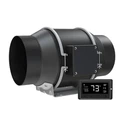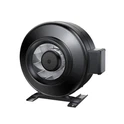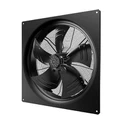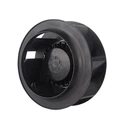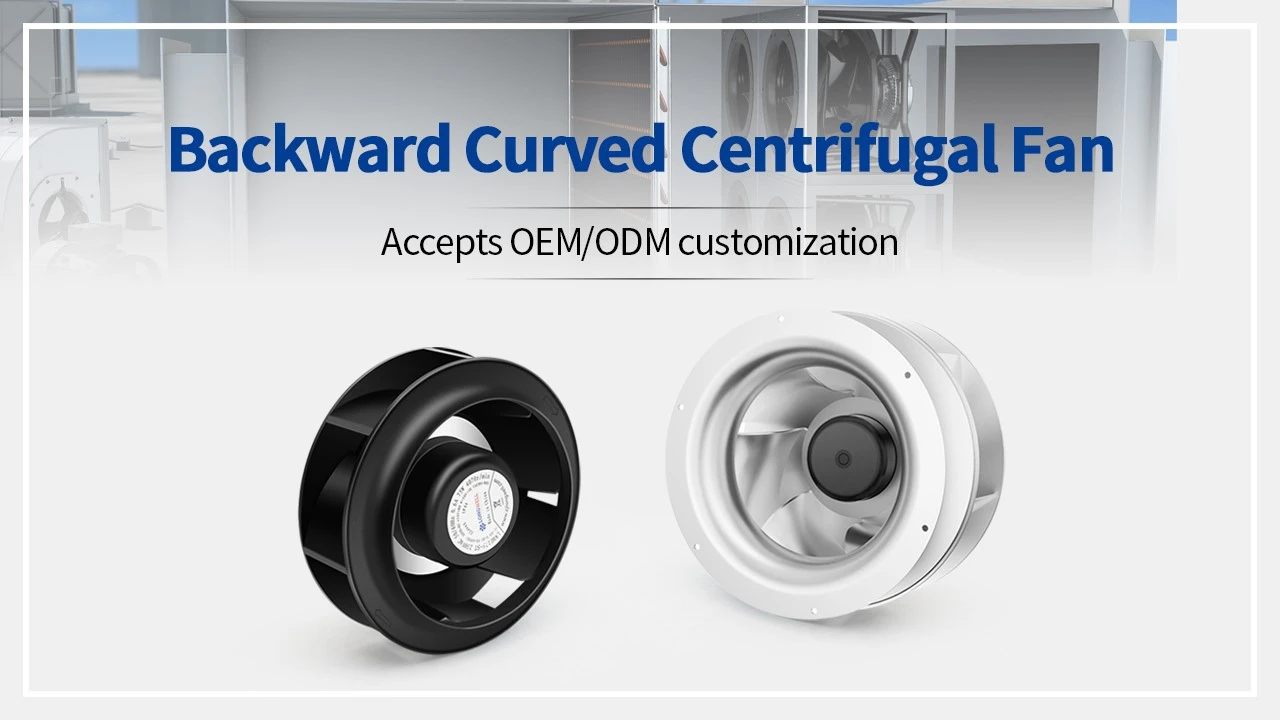
I: Product Classification
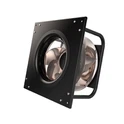
Backward centrifugal fans are classified by motors: AC, DC, EC (internal rotor motor). The EC series can be with or without brackets, while DC and AC can have custom brackets.
According to motors: AC 72/92/102/1038/188 DC 61/72/92/102 (single motor also has 37/53) EC 59/72/92/102/138/188/218
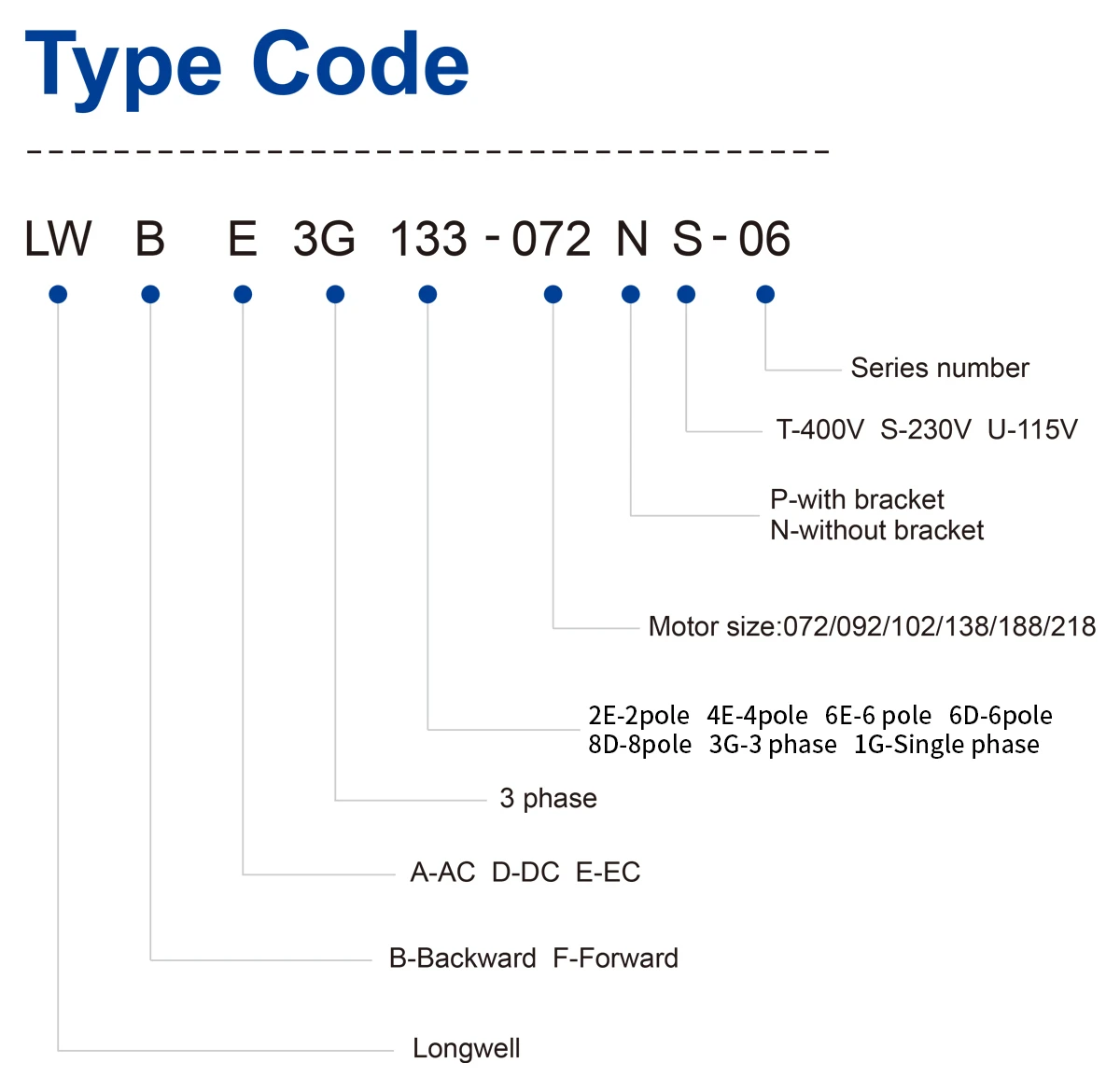
LONGWELL Backward Centrifugal Fan Naming:
II: Composition (Example of EC backward centrifugal fan)


Backward Centrifugal Fan Structure
III: Main Component Materials
Impeller: Plastic PA66+GF30%: 133/175/190/220/225/250mm (some models)
Galvanized Metal: 250/ (some models), 270/280
Aluminum Alloy: 250/280/310/355/400/450/500/560/630/710, original color, can be surface-treated
Inlet Ring: Each impeller needs a corresponding performance inlet ring; mainly made of galvanized metal, surface can be electrophoresis or spray-painted (black) Changing the size of the inlet ring requires mold opening (blanking mold + forming mold)
Bracket: Can be sheet metal bracket, bent pipe; materials: galvanized metal/cold plate/aluminum plate, surface electrophoresis or spray-painted, panel size and hole positions can be customized


IV: Electrical Parameters
AC Backward Centrifugal Fan:
Single-phase: 72/92/102 Voltage: 115V/220V Frequency: 50/60Hz (frequency depends on specific model) with distribution capacitor
Three-phase: 102/138/188 Voltage: 380V Frequency: 50Hz/60Hz
Voltage can be customized, for example: 230V/480V
(Different countries have different frequencies, 50Hz and 60Hz are not interchangeable, must distinguish; high temperature rise can burn the motor)
Protection Level: 72/92 IP44, 102/138/188 IP54
Insulation Class: Class F, can be made up to Class H (increases cost)
Operating Temperature: -40~+65 Can operate in the range of 65~120℃ with high-temperature components (increases cost)
(Motor 72 can be dual-speed, 92/102 can be three-speed, speed difference between high, medium, and low is above 200rpm)

DC Backward Centrifugal Fan:
Motor: 72/92/102
Voltage: DC 12v/24v/48v/80v/310v (80V mainly used for rail transportation)
Protection Level: 72/92: P44/IP54 102: IP54
Insulation Class: Class B
Operating Temperature: -25~+60℃, above 60℃, external control board is required
Speed Control: 0-10V (compatible with our company's DC speed controller 0-10V) or PWM
(DC80V: Compatible with 0-10V/PWM/RS485)

EC Backward Centrifugal Fan:
Single-phase: 72/92/102 Voltage: 115V/220V Frequency: 50Hz/60Hz universal
Three-phase: 102/138/188/218 Voltage: 380V Frequency: 50Hz/60Hz universal Three-phase voltage 208V can be developed
Note for voltage exceeding 480V
Protection Level: 72/92: Conventional P54 , replacement series IP55
Motor: 102/138/188/218: Conventional IP54 102 motor replacement series IP55
(When selecting, pay attention to whether the fan is used indoors or outdoors, outdoor control boards must be watered) (Rail transit control boards need to be potted)
Operating Temperature: -25~+60℃, above 60℃, external control board is required
Insulation Class: Class B/F, can be made up to Class H (slightly increased cost)
-40~-25℃ can also be customized
Speed Control: 0-10V/PWM/RS485/4-20mA, for 0-10V, it is recommended to choose LONGWELL Electric Technology Co., Ltd.'s EC speed controller
LONGWELL developed RS485 external control box, compatible with 72~138, compatible with 0-10V/PWM/RS485
LONGWELL latest version of 188/218 motors can be compatible with 0-10/PWM/RS485 with relay function com/nc/no

V: Product Advantages
AC/DC/EC Centrifugal Fans covers the basic sizes, power, and performance of mainstream impellers.
Replacement EC series performance and size can completely replace EXX products, motor is plastic-coated, protection level reaches IP54
AC/DC/EC series can have customized brackets, bracket material can be customized, surface treatment can be done, installation size and hole positions can be customized
Complete certification for the entire series of backward centrifugal fans, perfect supply chain, guaranteed quality
For DC/EC in environments above 60℃, an external control board solution can be used (external control box)
VI: Performance Selection
Air Volume: The volume of air circulation per unit time, unit cubic meters/hour (CHM), cubic feet/minute (CFM) m³/h≈1.7CFM
Static Pressure: The pressure exerted by gas on the surface of an object parallel to the airflow. Simply put, static pressure is the pressure that overcomes the resistance of the duct.
Dynamic Pressure: The conversion of the kinetic energy required for gas flow into pressure. In simple terms, dynamic pressure is the pressure that drives the forward movement of the gas.
Total Pressure: The difference between the total pressure on the outlet section of the fan and the total pressure on the inlet section.
Total Pressure = Static Pressure + Dynamic Pressure
Air volume is proportional to dynamic pressure. The larger the air volume, the smaller the static pressure. The larger the air volume, the smaller the static pressure.
System resistance refers to the total pressure loss of all pressure losses in the ventilation system, including filters, evaporators, condensers, baffles, dampers, and pipes along the way. It is usually positively correlated with the gas flow through the system. The typical system resistance curve is shown below. The operating point of the fan in the system is determined by the intersection of the system resistance curve and the fan's airflow static pressure curve. Usually, combined with the fan's efficiency curve, the operating point is set near the high-efficiency point of the efficiency curve to maximize the performance of the fan and save energy..

VII: Protection
Current Limit Protection
The motor real-time monitors the bus current. When the load increases and the DC bus current exceeds the specified value **A, it enters current limit protection. When the load decreases, it slowly exits current limit protection. Current limit protection is implemented by reducing the duty cycle (effective voltage of the winding). Therefore, if the load is particularly heavy, entering current limit protection may result in the actual speed being lower than the set speed.
Overcurrent Protection
When there is an FO protection (phase short circuit, etc.) signal, the motor immediately stops for protection. After the fault is cleared for 30s, if the power supply and command signals are normal, the motor restarts.
Overtemperature Protection
The motor control board is equipped with a temperature sensor NTC near the IGBT position. When the NTC senses a temperature of about 100°C, the motor stops for protection. After the motor stops, the temperature gradually decreases. When the NTC senses a temperature of about 80°C, if the power supply and command signals are normal, the motor restarts.
Locked Rotor Protection
When the motor starts, it will automatically judge whether it is locked. If the motor is locked, the motor will stop for 3s. If there is a 0-10VDC signal, it will restart. If it is still locked, it will stop for another 3s. If it is still locked and there is a valid 0-10VDC signal, it will restart. If it is continuously locked three times, the motor will stop for 3 minutes. If there is a valid 0-10VDC signal, this cycle will continue.
Low Voltage Stop Protection, Overvoltage Stop Protection
When the motor exceeds the voltage range, it stops running and returns to normal startup within the voltage range.
Input Power Loss Protection
For a three-phase power supply, if one or two phases are disconnected, the motor enters phase loss stop protection. When the input power is normal, the motor resumes startup.
0-10V Speed Control: It is a common voltage regulation method used to control the speed of motors or other electrical devices. The principle is to change the output power or speed of the device by adjusting the magnitude of the input voltage. In a 0-10V speed control system, a controller is typically used to generate a 0-10V output signal, which can be connected to the control circuit of the motor or device. When the controller outputs 0V, the speed or power of the device is at its minimum; when outputting 10V, the speed or power is at its maximum. By adjusting the output voltage of the controller, precise speed control of the device can be achieved. The 0-10V speed control system has advantages such as a wide speed range, high speed control accuracy, and fast dynamic response, making it suitable for scenes with high speed requirements, such as conveyor belts and robots on industrial production lines.
PWM Speed Control: It achieves the speed control function of motors or electrical devices by adjusting the duty cycle of the Pulse Width Modulation (PWM) signal. The principle of PWM speed control is to use rapidly switching PWM signals to control the speed or brightness of the motor or electrical device. By adjusting the duty cycle of the PWM signal, which is the ratio of the duration of the high level to the total period, the magnitude of the output level can be controlled, thus achieving speed control. In PWM speed control, the variation range of the duty cycle is usually from 0% to 100%. The larger the duty cycle, the higher the output level, and the greater the speed or brightness of the motor or device; vice versa. Precise speed control of motors or devices can be achieved by adjusting the duty cycle of the PWM signal, providing accurate speed control effects. PWM speed control is widely used in various motor controls, such as DC motors, stepper motors, brushless DC motors, etc.
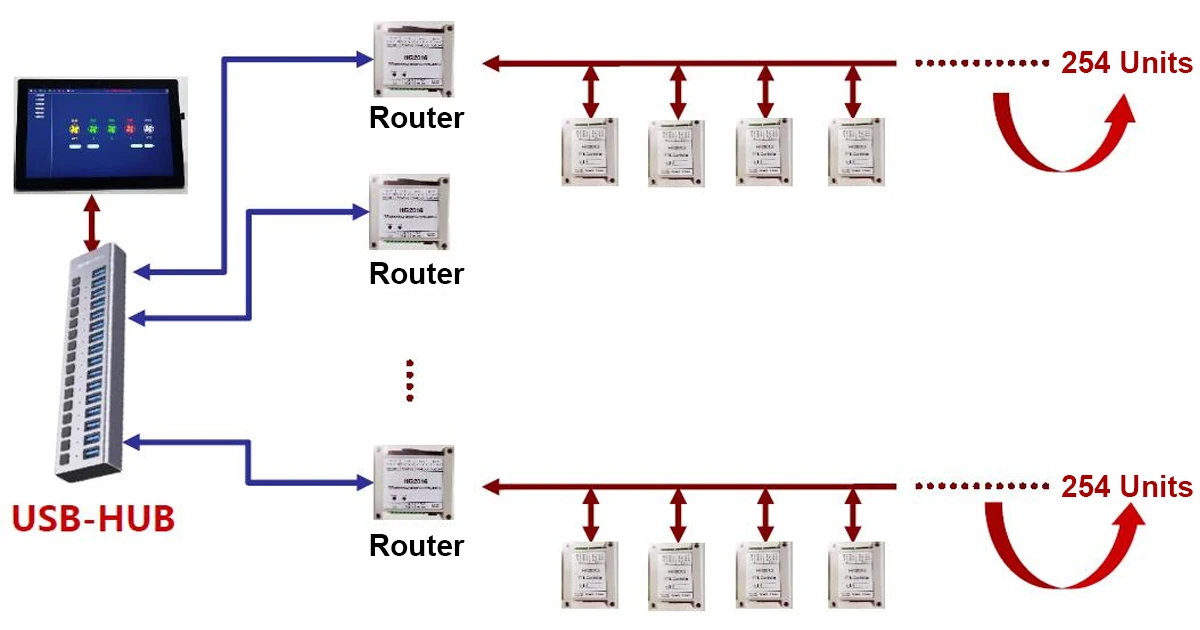
RS485 Speed Control: It achieves speed control using the RS485 communication protocol. RS485 is a multi-point oriented serial communication protocol that supports multiple devices communicating on the same communication line simultaneously. In RS485 speed control, there is typically a master device and multiple slave devices. The master device is responsible for sending speed control commands to the slave devices, which receive and execute these commands. The steps of RS485 speed control include: 1. The master device sends speed control commands to the slave devices, usually using a specific data frame format to represent the speed control command. 2. The slave device performs speed control operations based on the received command. 3. The slave device sends the speed control result back to the master device, usually using a specific data frame format to represent the speed control result. 4. The master device, upon receiving the result, can take appropriate measures as needed, such as adjusting speed control commands or displaying speed control results. The advantages of RS485 speed control include: 1. It can simultaneously control multiple devices, achieving efficient communication on a single communication line. 2. The RS485 communication protocol has high reliability and anti-interference capabilities, suitable for various environments. 3. RS485 speed control can expand the system capacity by increasing the number of slave devices.
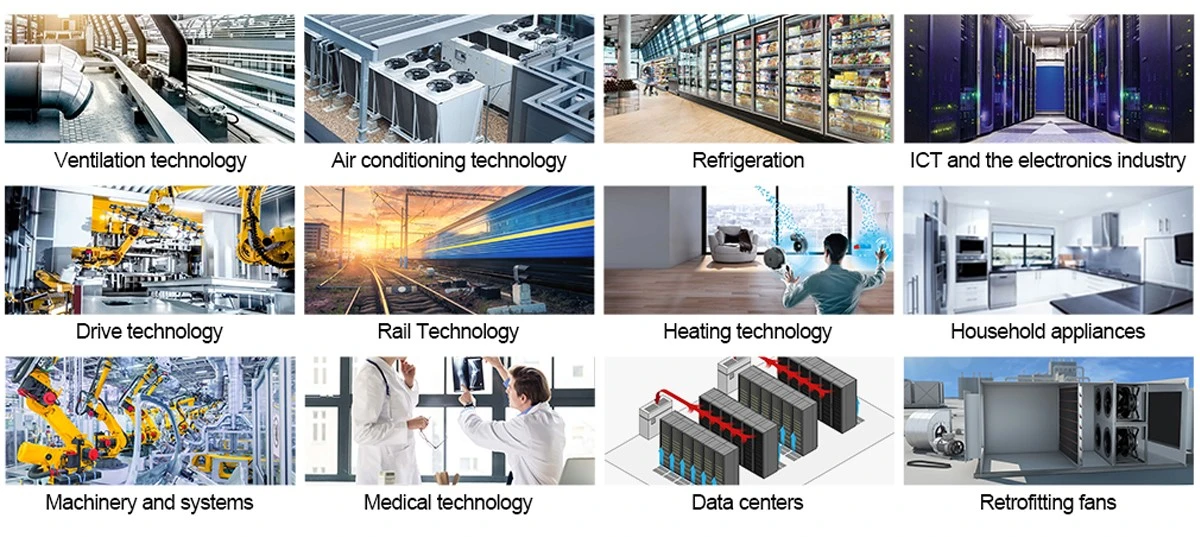
VIII: Application Devices of the Product:
Air purifiers, dehumidifiers, cabinet ventilation and heat dissipation, AHU, fresh air systems, air conditioning systems
Ventilation, dust removal, and cooling
Ventilation and induced draft for boilers and industrial furnaces
Cooling and ventilation in air conditioning equipment and household appliances
Drying and selecting grains
Cabinet enclosures (ventilation and heat dissipation)

Backward centrifugal fans are mainly used in the following fields:
HVAC (Heating, Ventilation, and Air Conditioning) systems: Backward centrifugal fans can be used for air conveyance, air circulation, ventilation, and exhaust in air conditioning systems.
Industrial ventilation systems: Backward centrifugal fans can be used for ventilation and exhaust in factories, workshops, and warehouses, ensuring air circulation and comfort in the working environment.
Electronic equipment cooling: Backward centrifugal fans can be used for heat dissipation and cooling in places such as electronic equipment, computer servers, and data centers to maintain normal operating temperatures.
Automobiles and vehicles: Backward centrifugal fans can be used in automobile engine cooling systems, in-car air conditioning systems, etc., to maintain vehicle performance and passenger comfort.
Agriculture and greenhouses: Backward centrifugal fans can be used for ventilation and air circulation in agricultural greenhouses, helping with plant growth and crop protection.
Chemical and process industries: Backward centrifugal fans can be used for gas transport, exhaust, and treatment in chemical plants and industrial processes, ensuring smooth process operations.
Water treatment and sewage treatment: Backward centrifugal fans can be used for gas blowing and ventilation in water treatment and sewage treatment plants, helping to remove pollutants from wastewater.
Medical equipment and laboratories: Backward centrifugal fans can be used for gas emission and ventilation in medical equipment and laboratories, ensuring safety and environmental hygiene. In summary, backward centrifugal fans have a wide range of applications in various fields, providing effective solutions for air circulation and gas treatment.
X: Main Market
Medium to large manufacturers and distributors of the above application areas and devices in Europe and North America
X: For details on EC backward centrifugal fans with brackets or without brackets, customization rules, etc., you can consult our company for free professional solutions.