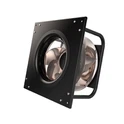
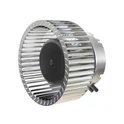
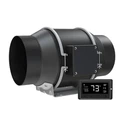
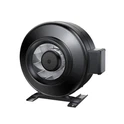
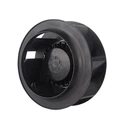
A centrifugal fan primarily consists of an impeller and a housing. In small fans, the impeller is directly mounted on the motor, while in medium and large fans, a coupling or pulley connects the impeller to the motor. Typically, centrifugal fans have a single-sided intake with a single-stage impeller. Fans with higher flow rates can have a double-sided intake with two back-to-back impellers, known as double-suction centrifugal fans.
When gas between the blades of a centrifugal fan rotates within the impeller, it acquires kinetic energy (dynamic pressure head) due to the centrifugal force. This energy is expelled from the impeller's periphery and, guided by the volute casing, flows towards the fan outlet. As a result, a negative pressure is formed at the center of the impeller, allowing external air to continuously enter to replenish it. This enables the fan to expel gases.
The motor transmits power to the fan impeller through the shaft, and the rotating impeller transfers energy to the air. Under the influence of this rotation, the air generates centrifugal force, causing it to disperse around the impeller's blades. In this context, a larger fan impeller results in the air absorbing more energy, leading to higher pressure (air pressure) for the fan. Reducing the size of a large impeller does not affect the airflow volume; it only reduces the air pressure.

The impeller is the primary component of the fan, and its geometric shape, size, number of blades, and manufacturing precision have a significant impact on performance. The impeller must undergo static or dynamic balancing to ensure the fan operates smoothly. Depending on the direction of the blade outlet, impellers are categorized as forward, radial, or backward. In forward impellers, the blade tips lean in the direction of impeller rotation, while radial impellers have blade tips oriented radially and can be straight-bladed or curved-bladed. Backward impellers have blade tips tilted in the opposite direction of impeller rotation.
For a given pressure generated by a forward impeller, a smaller impeller diameter is required, but efficiency is generally lower. In contrast, backward impellers produce lower pressure, requiring a larger impeller diameter, but they typically offer higher efficiency. Radial impellers fall in between. Blade profiles can be simple with straight blades or complex with airfoil-shaped blades.

To ensure an appropriate velocity distribution on the blade surfaces, curved blades are commonly used, such as equal-thickness arc blades. Impellers typically include a cover plate to increase strength and reduce gas leakage between the blades and the housing. The connection between the blades and the cover plate can be achieved through welding or riveting. Welded impellers are lightweight and offer smooth airflow paths. For low and medium-pressure small centrifugal fans, impellers are sometimes cast from aluminum alloy.